
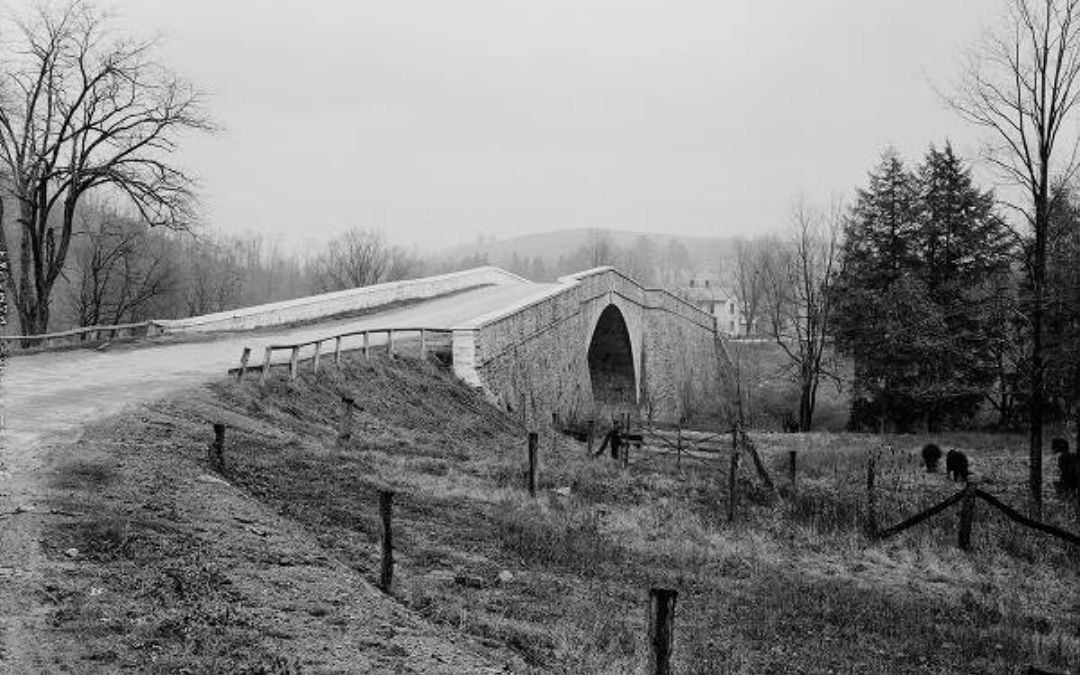
If you’ve driven through Grantsville lately, you’ve probably noticed the scaffolding wrapped around the historic Casselman River Bridge.
The restoration of the bridge is a collaborative effort between two key Maryland agencies working together to preserve one of the nation’s most significant transportation landmarks.
The Maryland Department of Natural Resources oversees the bridge as part of Casselman River Bridge State Park, while the Maryland State Highway Administration helped secure and administer funding through the Transportation Alternatives Program (TAP), a federal program supporting historic transportation and preservation projects.
Built in 1813-1815 as part of the National Road, the bridge was once the largest single-span stone arch bridge in the United States. A remarkable engineering achievement for its time, it also represented one of the nation’s earliest federally funded transportation projects.
Many believed such a structure could not be built. Yet, engineer David Shriver and the artisans working beside him accomplished exactly that, creating a bridge whose engineering continues to impress even modern experts.
“There’s a reason Roman aqueducts are still standing,” explained Linda Puffenberger, District Engineer for Maryland State Highway Administration District 6. “An arch with a keystone is one of the oldest technologies mankind has. It uses gravity to create strength and transfers weight naturally into the ground.”
Unlike many modern bridges built with steel and concrete systems requiring constant maintenance, the Casselman Bridge was constructed with locally sourced stone and an engineering approach refined over centuries. The result is a structure that has survived for more than two centuries and remains remarkably intact today.
Sarah Milbourne, Western Region Manager for the Maryland Park Service, said the current restoration project became necessary after State Park crews began noticing widening gaps and shifting stones in recent years.
“We realized we really needed to move toward a fix for this bridge,” Milbourne said. “Restoration is the word I lean into. We’re preserving the structure while making sure it remains here for future generations.”
Thankfully, the DNR and SHA organizations have a great working relationship and were able to collaborate to manage this restoration project. For those interested, progress updates and information can be found online.
The work happening now involves far more than patching mortar. Each stone is being cataloged and documented and specialists trained in historic preservation are carefully restoring the bridge using techniques designed to maintain its historical accuracy while also incorporating modern understanding of structural stability.
In many ways, the project resembles a blend of engineering and artistry.
“There are only so many people who do this kind of work,” Milbourne said. “It’s important for us to do it right because there are a lot of discerning eyes looking at this bridge.” Plans are tentatively showing a project completion in the spring of 2027.
However, the bridge itself carries many stories that reach far beyond impressive engineering.
Long before it became a state park, the crossing was known as “Little Crossings,” a name reportedly used by George Washington during his early surveying years in the region. Historians believe Washington traveled through the area extensively prior to becoming president while serving under British General Edward Braddock during the French and Indian War.
The National Road later became the primary route westward for the young United States. If people, supplies, livestock, or commerce moved west, there is a strong likelihood they crossed the Casselman River here in Grantsville.
“It really represented westward expansion,” Milbourne said. “This bridge was part of the gateway to the west.”
That importance has only deepened in recent years as historians continue uncovering additional stories tied to the site. Most notably, the bridge recently received recognition through the National Park Service’s Network to Freedom program after research connected the area to routes used by enslaved individuals seeking freedom. One documented figure tied to the route is Josiah Henson, whose life later helped inspire Harriet Beecher Stowe’s Uncle Tom’s Cabin.
Future signage and storytelling at the site will help tell these lesser-known stories. Mostly, the stories of the everyday people whose lives intersected at the crossing.
“It’s important for us to tell all stories,” Milbourne said. “The bridge served as a backdrop for travelers through all that time, and it will continue to do so.”
Today, visitors driving along modern Route 40 can still catch a glimpse of the bridge below, sitting quietly beside the newer transportation corridors that eventually replaced it. Interstate 68 rushes by nearby. Cars speed along realigned roadways designed for modern travel. Yet the old stone arch remains.
In the 1930s, traffic was rerouted off the bridge to a more aligned Route 40, a decision both Milbourne and Puffenberger credit with helping preserve the structure, even if unintentional.
Had heavy tractor-trailers and modern traffic continued crossing the bridge daily, the bridge probably would not have survived. But, the irony is that the bridge was closed to all vehicles in 1953 because there was no maintenance plan on the Casselman since the new bridge was opened.
Instead, the bridge became something rare: a preserved piece of living infrastructure history.
As we here in Garrett County prepare to celebrate America’s 250th anniversary and honor the people, places, and stories that shaped the nation, the Casselman River Bridge stands as one of the region’s clearest reminders that rural communities played a central role in building America.
Written by Sarah Myers.