
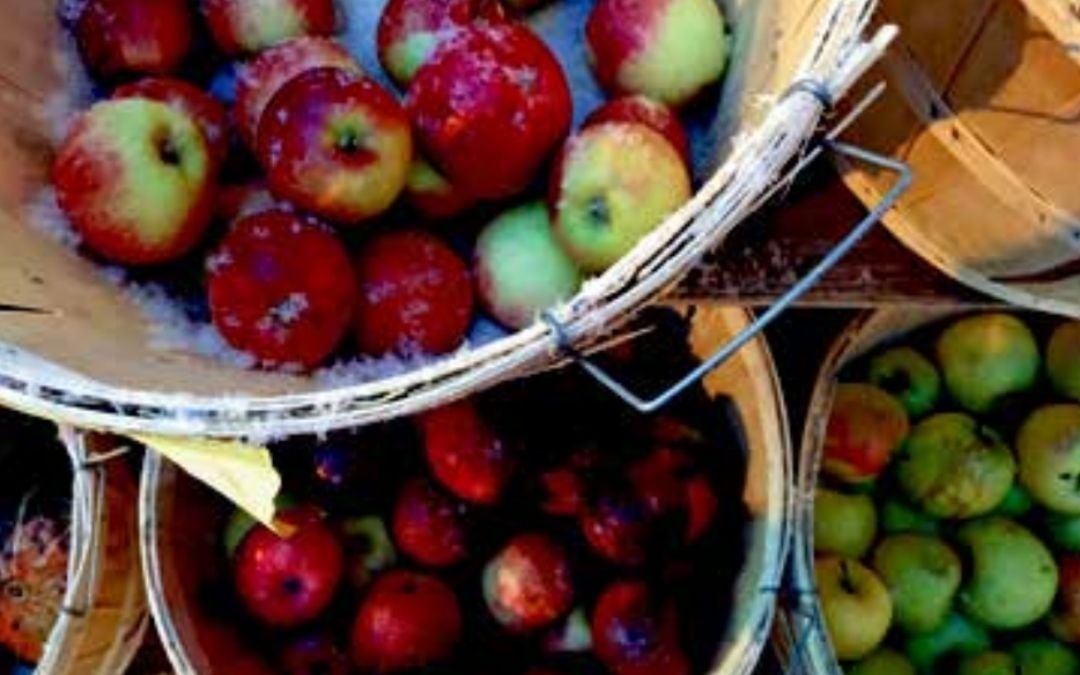
“Plant yourself an orchard because there is no better apple than the one you grew yourself!” -Jeannie Frazee, Garrett Soil Conservation District
This article is Part 1 of a two-part series about apples. Here in Garrett County, we’re surrounded by an abundant apple supply each fall. Part 1 looks at apple varieties in our area and how the cool nights and long, western Maryland winter shape the apple color, flavor and nutrition. Part 2 will talk more about nutrition, what those compounds actually do, and give suggestions for planting new, young apple trees around mid-April.
Apples (Malus domestica) are a big part of fall in Western Maryland, especially as we approach Autumn Glory. The cool weather in Garrett County keeps the apples crisp and somewhat easy to grow, provided you select cultivars that are disease resistant and thrive in cold weather. Apples, and their tempting derivatives (such as apple butter, apple cider, freshly pressed apple juice, dried apples, and of course apple pie) are widely available at local farmers’ markets throughout Garrett County.
Autumn Glory’s Cooler Colors!
Apples grown in cold weather are more colorful. According to the Farmers’ Almanac, “red apple skin gets much of its color from pigments called anthocyanins, and their development is strongly influenced by both sunlight and temperature.”
An ideal combination for color development is warm sunny days and cool nights. See Tim Konrad, “Cool September Nights Do Something Beautiful to Apples,” Farmers’ Almanac, Sept. 10, 2026.
Another recent article looked at the genetic factor utilized in pigment production, stating that a beautiful pair of genes in Malus domestica (MdGeBP3 and MdSPL6) “influences anthocyanin production under cold stress.” See Zhang et al., “MdSPL6 Regulates the Accumulation of Anthocyanins in Apple Leaves Induced by Low Temperature,” Horticultural Plant Journal, 2026. The Journal of Plant Physiology echoed the scientific discovery that “[cold exposure stimulates the genetic pathways that deepen red pigmentation].” See Wang et al., “The Role of Transcription Factor MdGeBP3 in Modulating Cold Stress Tolerance and Anthocyanin Biosynthesis in Apple,” Journal of Plant Physiology, Sept. 2026.
Apple Nutrition: Cold Weather Stresses Apples Out—In a Good Way!
The colder climate of western Maryland is a big benefit for producing a crisply delicious apple. When under stress, apples, like other edible plants, produce stress fighting chemicals. These chemicals make them more nutritious.
Garrett County sits in the westernmost, coldest spot in Maryland, which falls into USDA Hardiness Zones 5b–6a. See U.S. Dep’t of Agric., Plant Hardiness Zone Map, https://planthardiness.ars.usda.gov/ (2023). While the official zone range is 5–6, Garrett County’s plummeting winter temperatures can mimic zone 4.
Apples: Sweet-Tart and Sassy
Many studies have explained why cold weather apples taste better. Apples undergo cellular respiration (converting glucose into usable energy, carbon dioxide, and water). Colder temperatures make tastier apples because the process of cellular respiration slows way down, keeping the sugar in the apple longer. Cooler conditions increase acidity, color, and flavor development, and preserve the firm texture, which influences how the taste buds react.
One controlled study showed a direct connection between cooler early season conditions and apple quality for improving taste, texture, and crispness of the apple. Delayed fruit maturity improved the final fruit quality (Warrington et al., Apple Fruit Growth and Maturity Are Affected by Early Season Temperatures, 124 J. Am. Soc’y Hort. Sci. 468 (1999)).
Another effect of slow cellular respiration in cold weather is the apple’s ability to conserve malic acid. Malic acid is the primary organic acid in apples. Malic acid helps stabilize cell walls, allowing them to retain water and maintain pulp firmness. It creates that classic tart quality in apples that most apple lovers love.
Therefore, Garrett County’s ‘autumn-glorious’ pattern of sunny days, crisp nights, and distinctly abrupt cold causes the visually striking color and intense flavor. It’s the perfect recipe for the perfect apple.
Growing Apples Right Here in Garrett County
Does growing your own apples sound daunting? Garrett Soil Conservation District to the rescue!
The District works with local landowners on conservation, soil health, and the responsible use of natural resources. And its annual tree and shrub sale is one way it puts that mission into practice, giving residents access to plants selected with our local growing conditions in mind.
I spoke with Jeannie Frazee, who leads the local fruit tree and shrub sale.
“Growing apples in Garrett County can be a challenge,” says Jeannie, so “choose varieties that can handle zone 4 conditions, because although Garrett County is listed as zone 5, our unique weather patterns can often push temperatures below zone 5 for periods in the winter.”
Jeannie also recommends the “old heirloom trees that have grown here for the better part of the 1900’s or longer [which] have some natural disease resistance for the area, so they are a good choice.” Yellow Transparent, favored for making great applesauce, is a good one, along with Smokehouse.
And if Garrett 250 has you feeling especially patriotic, there’s an apple for that, too. Try the patriotic “Liberty” apple variety with its “ULTIMATE DISEASE RESISTANCE,” but get them while they last at the sale going on now, while supplies last.
See “Liberty” for sale at https://garrettsoilconservation.org/product/freedom/.
Happy Autumn Glory!
Also, look for Part 2 of this Apple series, and in the meantime, enjoy some farm-fresh local apples.
Written by MaryCarolyn Thies.