
The small town of Cranesville was established in the 1850’s by John Crane. Cranesville is primarily located in Preston County, West Virginia, but borders Garrett County, Maryland.
Probably the most notable feature about Cranesville is the Cranesville Swamp Preserve, once known as Cranesville Pine Swamp. It encompasses 1,774 acres across Preston County, West Virginia, and Garrett County, Maryland, and has been managed by The Nature Conservancy since 1960.
The Cranesville Swamp is a boreal peat bog relic left behind from the Pleistocene Epoch. The swamp formed 15,000 years ago during the last Ice Age, when glaciers inched close but never reached Maryland. The climate warmed, and the glaciers retreated, but many of the boreal plants remain to this day.
Nestled in a mountain valley bowl known as a frost pocket, colder conditions still prevail enough for plants to whisper of the past. The lush forest and wetlands of Cranesville Swamp are home to more than 48 rare plants and animals, including Jacob’s ladder, southern water shrew, and mountain earth snake. Red spruce and white pine trees have been restored by the thousands, and the Natural Area now supports thriving populations of wildlife such as American beavers, bobcats, and American black bears.
Rare species also abound, including the Endangered southern water shrew (Sorex palustris punctulatus), several birds such as the diminutive northern saw-whet owl (Aegolius acadicus) and the increasingly rare Nashville warbler (Vermivora ruficapilla), as well as many dragonflies, damselflies and butterflies.
Rare plants like the Endangered American larch (Larix laricina), a conifer that loses its needles in the winter, can be observed near the boardwalk. Other rarities are hidden away deep in the bog, like the endangered creeping snowberry (Gaultheria hispidula). The swamp has many different varieties of trees, but the most unusual one is the Tamarack; part of its uniqueness is that its needles turn yellow.
Visitors to the sanctuary may tour the swamp by a boardwalk leading into the bog. There they can see eastern larch, a northern deciduous swamp conifer, and other bog plants including cottongrass, cranberry, and the carnivorous sundew. The swamp was named a National Natural Landmark in 1964. There are five trails at Cranesville Swamp, including a 1,500-foot boardwalk. Although all trails are fewer than two miles and not difficult to walk, hiking boots are recommended as some trails may be muddy.
In the late 1800’s, Cranesville provided lumber when the lumber industry took off: pine, hemlock, oak, and chestnut.
Deep within the bog, small pockets of virgin forest remain, somehow missed by the logging locomotive named the Swamp Angel that passed directly through the wetland in the late 1800sand early 1900s, altering its hydrology. The Swamp Angel severely depleted the red spruce forests, and its sparks ignited the peak in fires that burned for weeks on end.
Early land distribution in the area emphasized fertile valleys and timbered uplands, setting the stage for communities like Cranesville to emerge amid the county’s growing population of German, Scotch-Irish, and English descent families.
The well-known hunter Meshach Browning wrote in 1859 that the area was filled with wildlife like panthers, wolves, bobcats, black bears, trout, and other wildlife.
The Browning Hotel, a summer hotel near the Cranesville side of the Browning Dam, a famous place for fishermen.
The Browning Dam was built in 1852, elevation 2541, by Meschach Browning’s two sons, Thomas and James, who built a dam to provide water to the grist mill on Muddy Creek. Originally, it was only with Brook Trout, with other varieties added later. There was a main clubhouse with twelve beds and several privately owned cottages. In the early days, men drove out in surreys or buggies. Sadly, the dam got washed out by high waters in the 1930’s.
In the late 19th century, Cranesville experienced growth through the establishment of mills and improved road networks that bolstered local agriculture and timber industries. Sadly, the grist mill was sold in 2017, dismantled, and moved out of state.
Cranesville has maintained population stability as an unincorporated area, with post-2000 emphases on sustainable land use through state and local programs promoting forest management and agricultural resilience in Preston County.
The Cranesville area is a rural area with homes, rolling hills, and pastoral views to enjoy on a ride to the swamp.
There are also some local family-run vacation rentals, https://cranesvillecountryrentals.com, which offer year-round hospitality in one of their six properties located in West Virginia bordering the Western Maryland line.
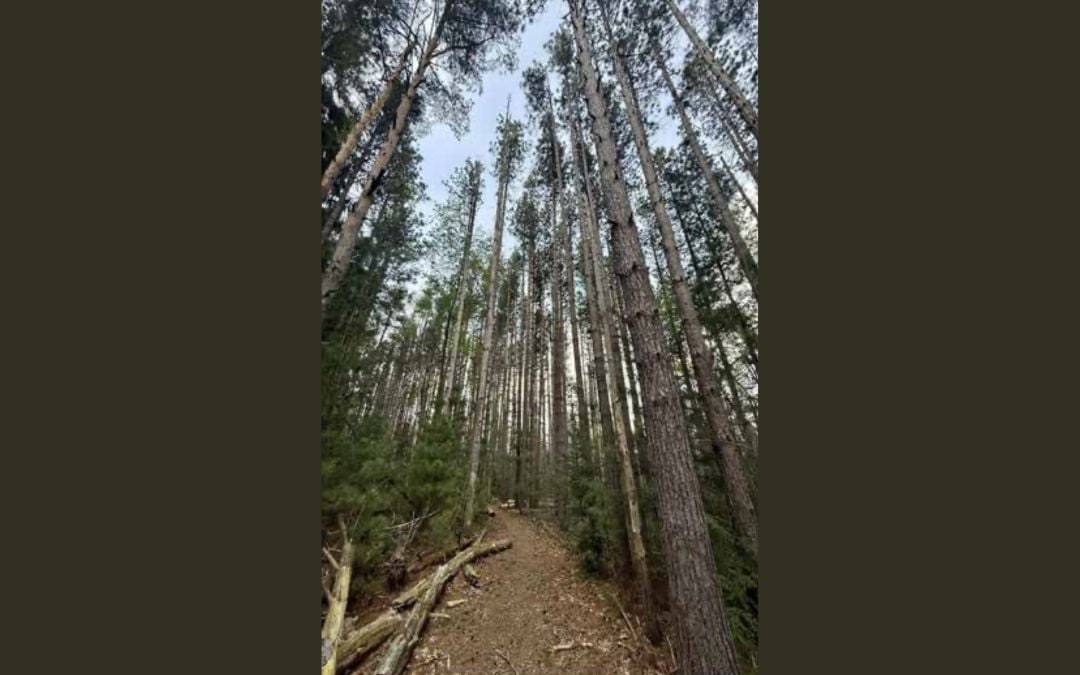
On a recent outing to the Cranesville Swamp Preserve in April, I got to witness the swamp awakening after a long cold winter. Here are a few pictures from along the blue trail. A pretty little flower called a gaywing or polygala paucifolia, color popped up from the side trails, offering a little color to the greenery.
It’s hard to imagine what the area would have looked like before the timber clearing, but it’s certainly a different feel, a most pleasant and peaceful feel, to walk among the pines.
Written by Robin Clutter.