At the 69th Garrett County Fair, local 4-H members showed off a year of their hard work. Now they’re already starting the work for their projects for next summer’s event. I spent a good part of fair week walking the barns and the 4-H building with a microphone, asking questions I probably should have known the answers to. I’ve been to this fair more times than I can count, and I left understanding, for the first time, how much of this happens when nobody’s watching.
The kids I talked to had been feeding their animals twice a day, walking them, bathing them and teaching them to turn with a light tap on the shoulder. As the public, we admire the ribbons, try to pet the cows, grab a Farm Bureau milkshake and head home. But as one of the 4-H leaders, Lacie, told me, “The Garrett County Fair is like our Super Bowl of the year. Our 4-H kids work on projects all year long.”
For the livestock kids, next year has already started. Pigs arrive around January or February, and lambs come in the spring. But steers are the biggest commitment of all. “Steers, you have to get all the way back in October,” an exhibitor explained. “You have to train year round.” Many of the kids who seemingly just walked out of the sale ring are already thinking about and planning for next year’s animals.
The daily work isn’t glamorous. Over in the sheep and goat barn, I met Carmen Knotts and Chase Preston, who walked me through the project of a market lamb and a Boer goat. One’s headed to market, the other is a breeding doe who’ll stay home and have babies. They explained that show lambs get sheared before every show, or about once a month otherwise, partly because a heavy coat hides the muscle a judge needs to feel. They leave the wool on the legs and ears on purpose: it makes the animal look bigger boned. Goats get supplements to fill out different parts of their bodies, and no, they don’t eat everything. That’s a myth, they told me, with the patience of people who’ve explained it before.
I also learned that sheep and goats don’t usually live together, because goats need copper in their minerals while copper can kill a lamb. And that sheep produce a natural oil called lanolin that sheds rain right off their backs, which is why you only shear a mama sheep twice a year. I asked if they were feeding their goats pennies. They were kind about it.
Pigs, meanwhile, need to be walked every day, or they won’t know what to do when they get in the ring. “You just have to be dedicated,” one pig exhibitor told me. “You have to go walk your pig, you have to practice. You can’t just feed it every night and not touch it ever. Once you show it, it’s not gonna know what to do.” The judges can tell. In market classes, they’re looking at the animal: the muscle, the build, how well it gained. In showmanship, they’re judging the kid. A pig that walks calmly and turns on cue tells the judge somebody put in the hours.
What surprised me the most was how much these kids know about entrepreneurship and money. One pig exhibitor bought his hog with a loan from his mom. After sale day, he pays back the cost of the pig and his expenses, and whatever’s left is his. “We still have fun money afterwards,” he said. And he’s got plans for it: “I’m saving up for college and a car.” At 14. His friend switched from lambs to pigs, and she’ll tell you it came down to dollars and cents. Lambs were often sold by the head, which didn’t always cover the cost of feed and the cost of paying someone to shear them. Pigs sell by the pound, so if you raise a good one, it shows up in the check.
On sale day, the kids get all dressed up again and walk into the ring alone while local businesses and neighbors bid. Sometimes a buyer even donates the animal right back to the kid who raised it. Of course, raising a market animal has an emotional side. The pig or lamb or cow you’ve named and fed and walked all year will be sold, and most go to market. I asked about it, and I’m sure my face showed what I was thinking. “It’s very sad,” one young exhibitor said. “You just have to prepare yourself. That’s why I don’t get attached to my market animals as much as the breeding ones.” “They serve their purpose as a good show animal,” the exhibitor said, “and then for other people to eat.”
And if you think 4-H is all animals, Luke would like a word. “Everyone usually thinks 4-H is only about showing the animals,” said the 14-year-old from the North Glade 4-H Club, who’s been a member for six years. “But there’s a lot of other things that come into it.” This year Luke soldered a working flashlight out of an Altoids tin at an engineering workshop. He also competed in tractor driving, which means weaving a lawn tractor through cones and backing a manure spreader in and out of a mock garage. “I usually hit a couple cones,” he admitted. He’s thinking about a career in engineering. And, his favorite part of fair week? Showing his pig and the peach milkshakes.
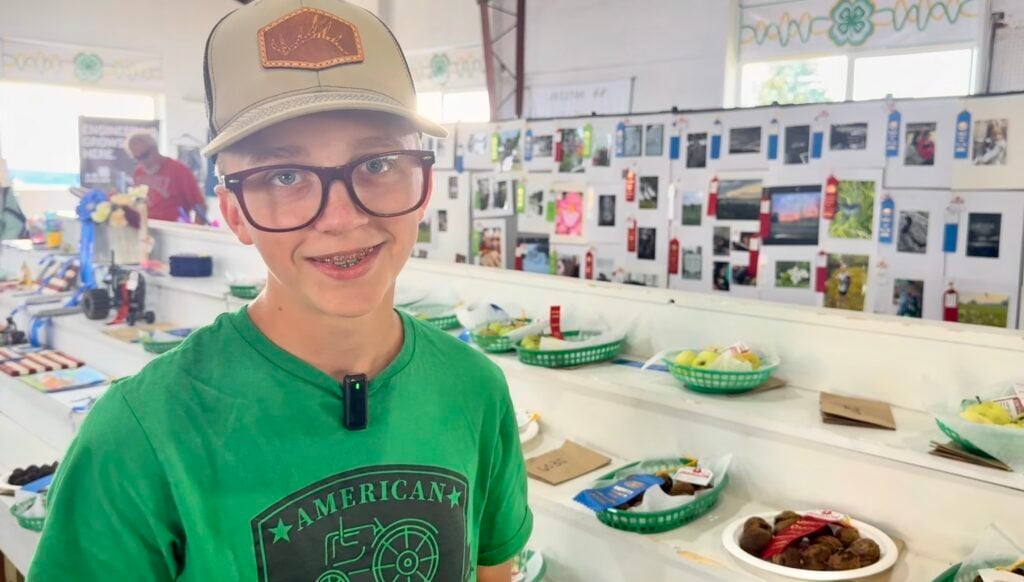
Luke shares his 4-H projects
He wasn’t the only one who came out of that soldering class fired up. Cassidy told me she’d never held a soldering iron before and loved it, mostly because it’s not something most families have lying around the house. She showed me her flashlight, peeling the tape off one side, and pointed out the LED, the battery and the switch like she’d built it yesterday. Then she told me about the crafting corner she’s set up in her sunroom.
Walking through the 4-H building, I couldn’t believe the range of projects. Photography, baked goods, metalwork, Legos, duct-tape crafts, tie-dye, diamond art, 3D printing. There were even chestnuts, which I, embarrassingly, did not recognize. The formal table settings category is one of the oldest classes still going strong: kids pick a theme, write a menu, and put every piece in its proper place. “If a kid has a hobby, there’s a class for about everything under the sun,” one of the leaders told me. When the kids’ interests change, the classes change with them. 3D printing was added a few years ago, and then 3D pens got a class of their own. Fairy gardens showed up about three years back, right after one of the county’s 4-H educators taught fairy garden classes in the schools. I pitched a drone photography category. They haven’t been asked that yet, but they said they probably will be adding it in the near future.
Ashley Bodkins, who runs the county’s Master Gardener and home horticulture programs, walked me through how the exhibits actually get judged, fair book in hand. It’s a thick book, over 100 pages, and it spells out everything: five stems for flowers, ten tomatoes on a plate. Beyond the rules, judges look for uniformity. “It’s really a lot harder for somebody to get ten tomatoes that are all uniform versus something that calls for like one single entry,” she said. Bigger isn’t always better, either. She tells kids to think about it this way: what would you want to pick out of your own garden to eat, or grab off the shelf at the grocery store? That’s your entry.
And every item is judged blind. Exhibitors get a number at the fair office, and that’s all the judge sees. Here’s the part I didn’t expect. There’s no rule that a kid has to grow a flower from seed. They can walk out the morning of the fair, look around the yard, and cut something. They’re encouraged to know what it is and which class it belongs in, but the point isn’t to keep people out. “We want to encourage people to participate and we do want it to be a learning experience,” Ashley said. Which is a good reminder for anybody who’s ever assumed the fair wasn’t for them.
Sewing is having a moment too. One girl turned a thrifted jumpsuit into a shirt and pants. Another stitched a skirt out of her family’s old jeans, so now she wears it to church, “wearing the memories of all her family members at the same time.” At the fashion review, the kids model what they made and then sit for an interview about how they made it, what it cost, and how many times they’ll realistically wear it.
Cassidy took home a Best of Show ribbon for her blue floral dress, and she learned to sew at home. “I wish we had home ec, but we don’t anymore,” she said. “So this is kind of the only way I can learn.” Most of her fabric is repurposed. Her purse is old jeans and bed sheets. Last year’s outfit came from curtains. What she loved most, she said, was walking to the show and having people she’d never spoken to stop her to ask if she’d really made her dress.
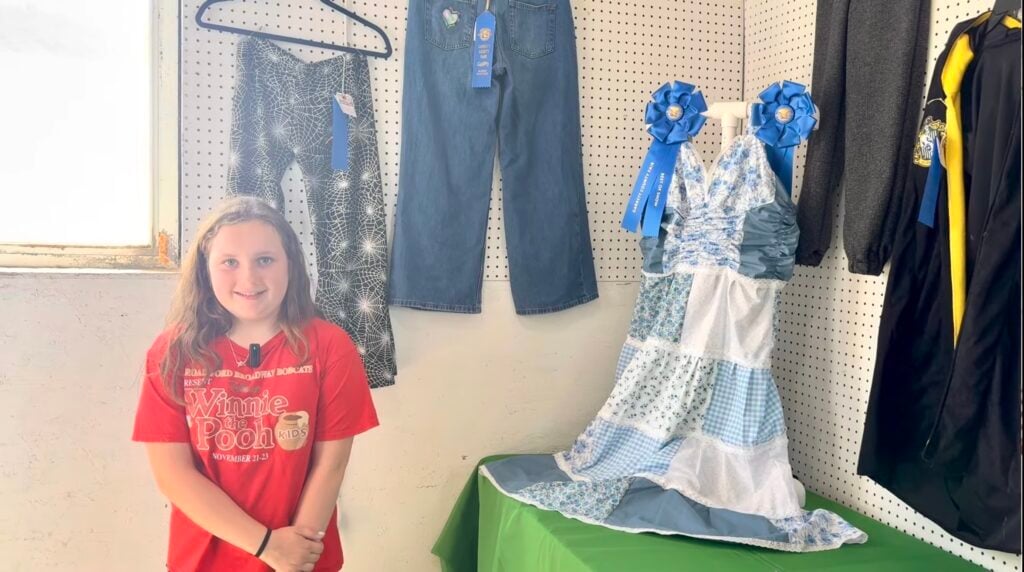
Cassidy Poses by her Award-Winning Sewing Project
For the adults behind the program, the ribbons are almost beside the point. Lacie Ashby is the 4-H educator with University of Maryland Extension here in Garrett County, and she grew up in the program herself. “It’s not about learning a fact,” she said. “It’s about the life skills that come along with it.” She means public speaking, teamwork, working with people of every age, and having trusted adults in your corner besides your parents.
Garrett County’s program runs on more than 100 volunteers across about 15 clubs, which meet monthly in pockets all over the county. Membership is open to ages 8 to 18, with Clovers as young as 5, and it costs $10 a year.
At 4-H camp, a five-day overnight leadership camp, the older kids become group leaders for the younger ones. Four nights in a cabin with no air conditioning, I’m told, will bond a group of strangers fast. “For you to have a teenager that leaves sports to take a little kid to the nurse and waits with them while they get the Band-Aid on, forfeiting their own fun to take care of someone else,” Lacie said, “it’s really heartwarming to see how well they grow.”
Ashley, who was a 4-H member her whole childhood before joining Extension in West Virginia, summed it up with the motto she grew up on: To make the best better. “You’re learning something, you’re helping someone else,” she said.
I’ve lived here my whole life and never really understood everything 4-H does. Now I do. The fair barns are empty, but somewhere in Garrett County, a steer is about to meet its new owner, and training for next August’s Super Bowl has already begun.
Get involved: Maryland 4-H is open to ages 8–18 as of Jan. 1, with Clovers ages 5–7. Enrollment is $10 a year, and about 15 clubs meet monthly across Garrett County.
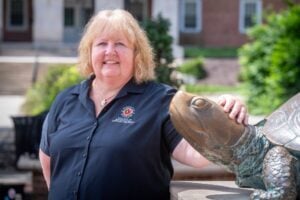
A conversation with Wendy Powers, Dean of the University of Maryland College of Agriculture and Natural Resources
AGNR Dean Dr. Wendy Powers
What is your background? How did you end up leading a college of agriculture?
I grew up in the city in New York State and I learned about [Extension] when I went to college and met some people who were in Extension, and I immediately thought, I want to be part of that. I ended up becoming a faculty member with an Extension appointment in animal science and ag engineering, and eventually went into administration so I could better promote Extension and all the work going on.
What did you think of your first Garrett County Fair?
I think it’s wonderful. It’s a large fair, it’s really well attended, beautiful facilities. I’m impressed, and I’m sure I’ll be back.
What is Extension?
I like to think of Extension as the local front door to the University of Maryland. The people living and working in your community are your first introduction to the university, but everyone has access to the school’s full resources.
What programs go on at the Extension office?
Agriculture and natural resources is a big one, but it’s also water quality, nutrition andwell-being, home finance, climate impacts, crop losses. It’s a whole host of things. It’s a huge organization.
What’s the best-kept secret?
Many people probably don’t know that 4-H works within Cooperative Extension. It’s the youth development arm, and it’s the largest youth development organization in the country!
Her advice: Please reach out to your local Garrett County office and see what’s available. The local number is 301-334-6960 or stop in the Oakland office near Freedom Ag and Energy.