
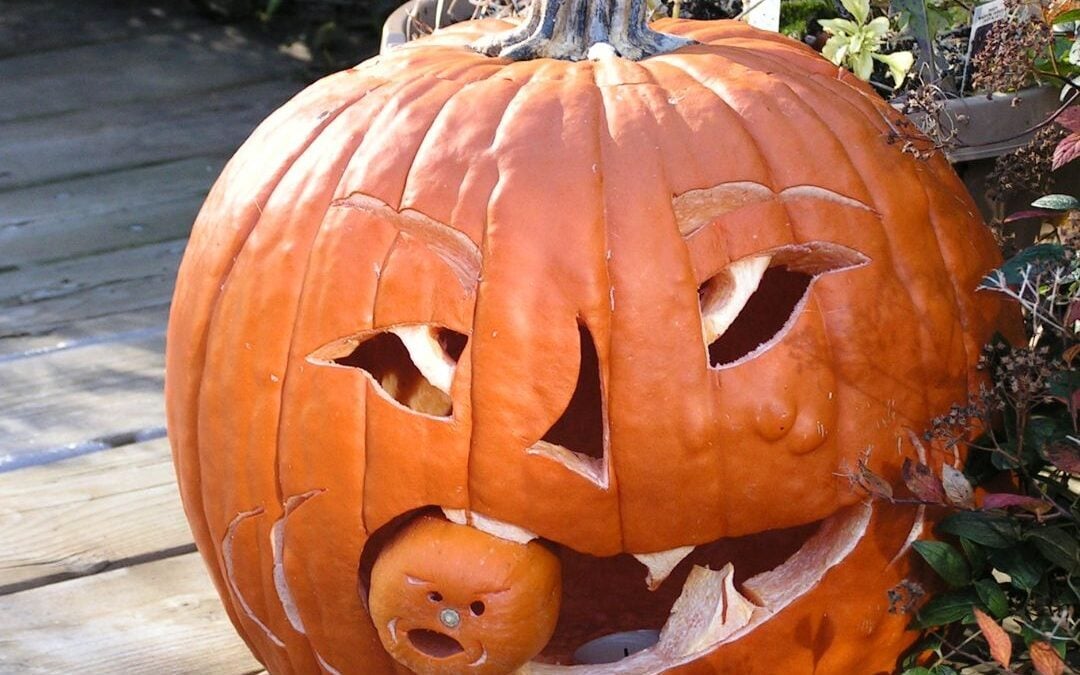
Later on this month you’ll be overcome with the irresistible desire to plunge a knife into a fruit…a very big fruit. It won’t be pretty…well…maybe it will be, but you’ll need some practice if you haven’t done this since the Truman administration. Nevertheless, pumpkins are fruits. Fruits come from the flowers of plants and hold seeds, while vegetables are the other edible parts, like the roots, leaves, and stems.
Word on the street is the Irish started this fruit piercing ritual. It’s a little-known fact that pumpkins were not native to Ireland. So, they speared turnips, rutabagas, gourds, potatoes and beets. They were indiscriminate veggie carvers. Why? To light their way after dark. Okay, but how, and why?
Lighting the turnips was accomplished by placing an ember inside to frighten away nocturnal evil spirits. Good thing turnips are not explosive. Whether or not evil spirits are explosive is unknown because they stayed away from the glowing turnips. You might say, “Mission accomplished”.
This turnip assaulting happened on All Hallow’s Eve when evil spirits roamed the night. I’m not certain how the costume tradition got started but I suspect leprechauns had something to do with it. Leprechauns are not to be confused with elves. Elves live in hollow trees and bake cookies. However, they belong to a different guild. But, I digress.
The name “Jack-O-Lantern” referred to strange lights called jack-o’-lanterns or will-o’-the-wisps flickering over peat bogs. Cultures worldwide have their own version. I don’t think this is at all related to McHenry’s Will O’ The Wisp but I could be wrong, you never know. It is suggested that the name also has ties to the Irish legend of Stingy Jack, a drunkard who bargains with Satan and is doomed to roam the Earth with only a hollowed turnip to light his way. Now THIS sounds like something worth learning about.
According to Wikipedia, an 1836 edition of the Irish Dublin Penny Journal reported that several centuries earlier, there lived a drunkard known as Stingy Jack. He was known throughout the land as a deceiver and manipulator. One night, Satan overheard of Jack’s evil deeds and persuasiveness. The devil went to find out for himself whether or not Jack lived up to his vile reputation. Now the plot thickens.
Typical of Jack, he was drunk and wandering around at night when he came upon the devil himself! Jack realized that this was his end because Satan had finally come to collect Jack’s soul. So, Jack made a last request, asking the devil to let him drink ale before he departed to Hell. “Why not?” thought Satan. Satan took Jack to the local saloon and gave him beaucoup beers. After slaking his thirst, Jack asked Satan to pay the tab. Satan never carried cash, nor credit cards, so Jack convinced Satan to turn himself into a silver coin to pay the bartender. The Devil could change back when the bartender wasn’t looking. Satan did so. Jack stuck the remodeled Satan-coin into his pocket, which also contained a crucifix, preventing the devil from escaping. This forced Satan to agree to Jack’s demand: in exchange for Satan’s freedom, he had to spare Jack’s soul for another ten years. Boy, oh boy – that Jack could sell ice to the Eskimos.
Ten years later, Jack met the devil again. Jack accepted it was his time to go to Hell. As Satan prepared to take him, Jack asked if he could have one apple to feed his starving belly. Foolishly, Satan said, “Okee dokee”. As Satan climbed up the apple tree, Jack surrounded its base with crucifixes. Satan, frustrated at having been snookered again, demanded to be released. Jack made another demand: that Satan will never take his soul to Hell. Having no choice, the devil agreed and Jack was set free.
Eventually, the drinking took its toll on Jack, and he died. Jack’s soul was about to enter heaven, but he was refused because of his sinful lifestyle. He then went down to the Gates of Hell and begged for admission. Satan, fulfilling his promise to Jack, could not take his soul. Instead he gave Jack an ember in a turnip to light his way. Jack was doomed to roam the world between the planes of good and evil, with only an ember inside a hollowed turnip (probably a large rutabaga) to light his way. To this day, you can see Jack wandering over peat bogs, swamps, and such.
In the 1800s, Irish immigrants came to America, bringing their myths with them. They quickly discovered that the larger pumpkins were easier to carve than were turnips, or rutabagas. So, they used pumpkins for Jack-O’-Lanterns. I believe they also considered watermelons but the juice kept extinguishing the candle. So, there you have it.
Wow! What a story! But, turnip or rutabaga, what’s the skinny about pumpkins? The earliest evidence of pumpkin cultivation dates back 7,000-10,000 years in North America, specifically in Mexico and the southwestern United States. Apparently, this “cultivation” got out of control and contests began to see who could grow the biggest pumpkin.
According to Guinness World Records, the current world pumpkin record is 2,749 pounds and was registered in 2023. The pumpkin started out basketball round. As it grew, it ended up looking more like a flying saucer, but nevertheless a record-breaking size. The record was confirmed by the Great Pumpkin Commonwealth (see Face- book). More leprechaun shenanigans, no doubt.
Written by Tony Lolli.