
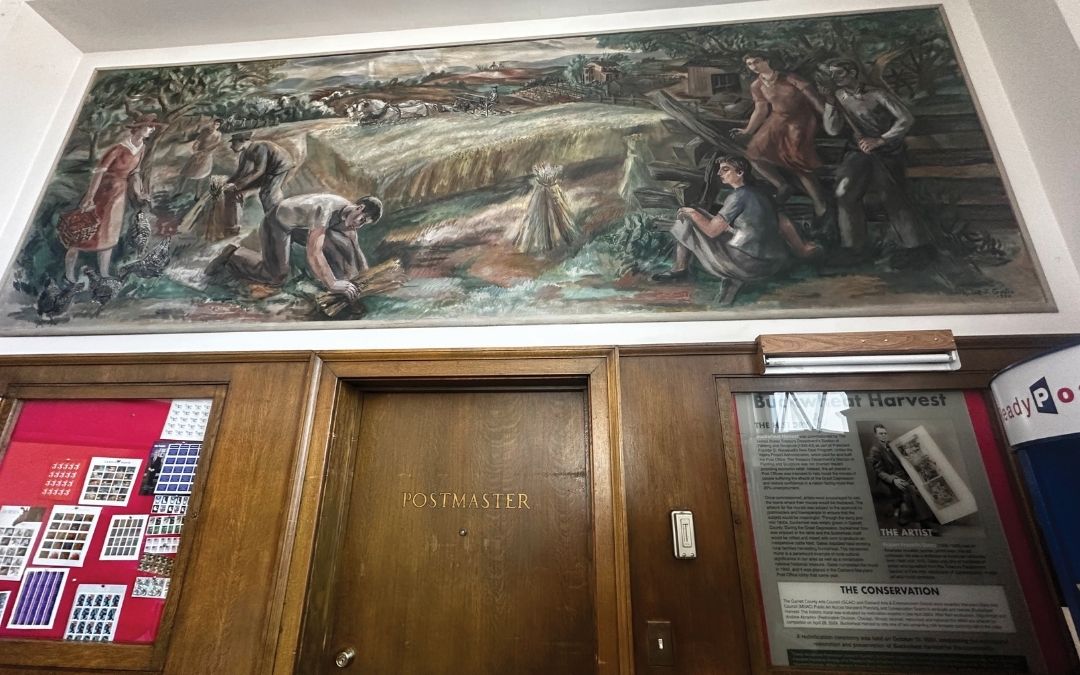
Standing in the lobby of the Oakland Post Office will instantly immerse a guest in multiple types of history. The building itself, built in the 1930’s, is classified as a historical building, and it is also a highly sought destination for art enthusiasts. Inside the main lobby of the building resides an original mural by Robert Gates, commissioned as part of Franklin D. Roosevelt’s New Deal initiative to beautify the nation and raise the spirits of the American people following the Great Depression.
Over 1,000 murals were commissioned between 1934 and 1943 by The Treasury Department’s The Section of Fine Arts with the specific requirement that each mural depict American Life and be specific to the local area. Gates’s mural, titled “Buckwheat Harvest,” portrays a simplistic and picturesque version of farm work with both male and female laborers using simple farm tools to harvest buckwheat. The crop was a significant part of daily life in Garrett County at the time, used as a substitute feed for livestock, as well as in flour. Buckwheat cakes, which were pancakes made of the flour, were a popular meal because they could feed a large family at low financial cost. Due to its rapid turnover in the field, buckwheat was also known as a “backup crop” for farmers if the intended crop for the land did not produce. Buckwheat could be planted in July and harvested in October. Buckwheat was such an essential part of agricultural growth after the Great Depression that local communities even held an annual festival to celebrate the crop.
Gates’s landscape mural greets viewers with warm colors depicting Garrett County’s famous mountainous scenery in the background, with active physical labor of harvesting in the foreground. Cool colors are also used throughout the mural to create the feeling of shade and a sense of refuge for the workers. The collective laborers depict both focus and determination, with their eyes concentrated on the manual labor of harvesting the buckwheat by hand. Healthy, green foliage on both the trees and bushes adds a layer of lushness to the scene and conveys the desired sense of hope and optimism, which was one of the main tenants of Roosevelt’s New Deal initiative. Gates’s mural was a familiar scene to local residents at the time and was a reminder of not only what had been, with a bountiful farm, and instilled a hope of what was on the horizon.
Gates was a well-known artist and educator who taught at the American University for three decades. He was known for his admiration of the area, spending his summers in Allegheny and Garrett Counties. He was contacted directly by The Section of Fine Arts to solicit his interest in painting the mural, and it was one of four paintings that Gates was commissioned for, including other post office murals in Bethesda, Maryland, and Lewisburg, West Virginia. The Oakland mural was completed by 1942 and is of particular interest to artists due to the type of paint, milk tempera, that was used to paint it. Additional works by Gates have also been displayed at the National Gallery of Art and the Metropolitan Museum of Art in New York City.
Historical documents record the loss of hundreds of these murals that were painted as part of the New Deal’s initiative due to fire, construction, or demolition of the building it was housed in. Not only is Gates’s mural still fully intact, but it has recently been preserved in a restoration commissioned by the Garrett County Arts Council, funded by a grant from the Maryland State Arts Council Public Art Across Maryland Planning and Conservation Grants. As conservators began the restoration process, completed in 2024, it was noted that the original paint layer did not have significant damage to it, and the mural was well preserved. For art enthusiasts, a video documenting the restoration process, titled Opening the Gates, can be found on Vimeo. The documentary draws on the expertise of local residents who are members of the Garrett County Historical Society, as well as the Oakland Arts and Entertainment District, who speak to not only the history of the mural, but the significance of it being still intact and viewable by the public. While the New Deal lasted for ten years and did largely succeed in having restorative power after the Great Depression, those who were an active part of the movement are being outlived by the buildings and artwork created during the era. The residents of Oakland take great pride in being home to Gates’s mural and preserving its history.
The lobby of the post office, located on S. 22nd Street, is open 24 hours a day, seven days a week, allowing easy access to visitors who would like to view the mural.
Written by Francesca Branson.