
The area of Deep Creek Lake and Garrett County would not be what it is today without the Baltimore & Ohio (B&O) railroad. The B&O line that ran through Oakland was a pivotal factor in opening the area to tourism, and John Work Garrett, for whom the county is named, was a key strategist and leader in these efforts.
Bringing the B&O line through the Alleghany mountains, from its origin point in Baltimore, was a task met with multiple challenges. The first of which was the intense competition from the Pennsylvania Railroad (PRR), which was also laying down tracks at the same time that the B&O was. The two rail lines both aspired to be the major railroad of the west and were competing against each other to provide the fastest, most convenient service at the best rates. The B&O won the contract with a proposal that facilitated a rail line that would travel at a lower elevation than the one proposed by PRR, which would allow for lower long-term costs for the railroad. Nonetheless, the B&O was staring down an incredible challenge to continue the railroad through the mountainous terrain of the Alleghany Mountains.
When the B&O arrived in Cumberland in 1842, engineers first considered going around the Eastern Continental Divide to proceed through the mountains,s and while that would have been the easiest plan at the time, it was not the most direct path, which would slow down the train and the essential freight, such as coal and lumber, it was carrying. Over 5,000 men and 1200 horses contributed to the construction of the railroad, using picks, shovels, and black powder explosives as their main tools to lay the tracks through the mountain from Cumberland to Oakland.
In anticipation of the railroad running through the area of Oakland, known as Oak Grove in the 1840’s, the streets of Oakland were laid out in 1849, two years before the train officially passed through the area in 1851. By the mid 1850’s, Oakland became a hub for coal and lumber, and in 1858, Garrett became the president of the B&O railroad. At the onset of his presidency, Garrett observed that the beautiful scenery and cooler summer weather of the area could be a draw for tourists, now that it was easily accessible by railroad. However, the lack of local hotel accommodations put a limit on visitors to the area.
Under Garrett’s leadership, the B&O constructed two hotels in the area. One near Oakland and one just a few miles away in Deer Park. The Deer Park Hotel, built in 1873, was known for its luxury and expansive grounds and attracted wealthy and distinguished guests, including Presidents.
Cleveland, Harrison, and Grant. Garrett also built multiple cottages on the same land as the hotel for him and his family to reside in. Western Maryland indeed began to see a boom of tourists in the summer months as travelers sought out the area to beat the summer heat.
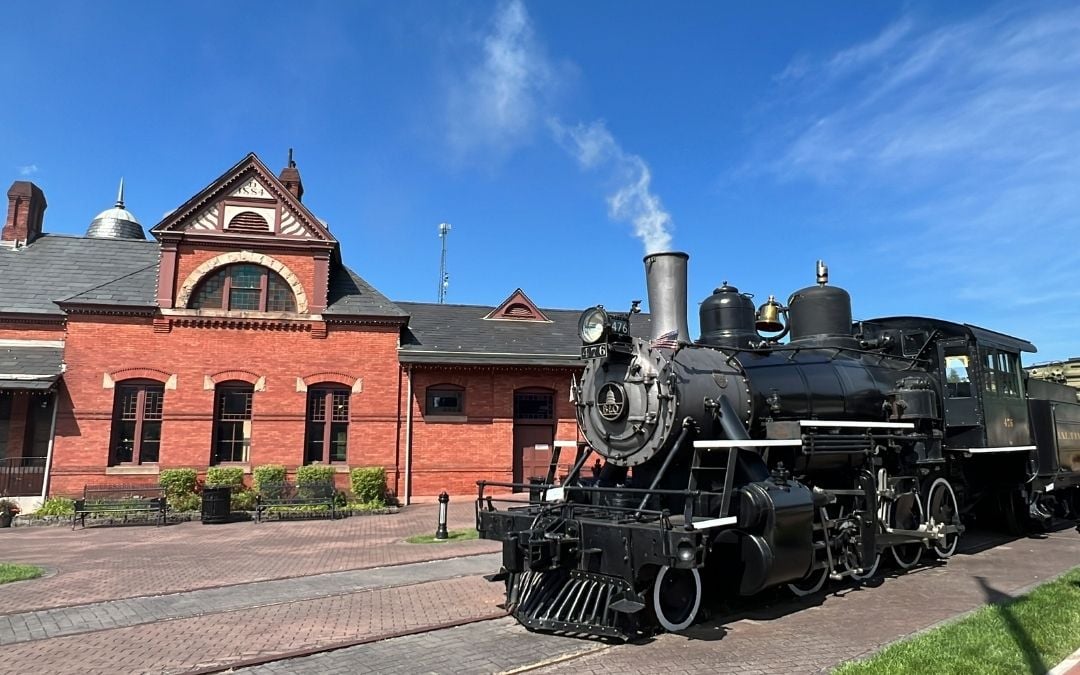
The Oakland B&O Museum, on Liberty Street, exhibits multiple aspects of the railroad that was influential in forming the area. The Oakland station was built in 1884, almost twenty years after the first train passed through the area. Known for its Queen Anne railroad architecture, the station served passengers until 1971. With the opening of the Wisp Ski resort in 1955, the railroad provided access to a ski resort that tourists would not have otherwise been able to access due to poor road conditions in the snowy winter months. While at the museum, present-day guests may even observe a train running on the railroad during their visit. The CSX Corporation bought out B&O and continues to use the railroad through Garrett County to transport coal.
The history of the B&O track comes to life before even stepping foot into the Oakland museum. Sitting on a track outside, visible from the street, is a steam locomotive, no. 476 was built by Baldwin Locomotive Works. The particular engine in Oakland was never used on the B&O; however, it is a counterpart of the engines that were considered the height of technology in the 1920’s.
Terry Helbig, a volunteer at the Oakland B&O Museum, explained that the museum obtained the engine to contribute to the historical significance that the museum unfolds for the visitors. “Occasionally, we turn it on and produce what looks like steam coming out of it, like it would have when it is operational. The ‘steam’ folks see when we do that is not from coal, but from animal fat. One time, we produced so much ‘steam’ in one day, the fire department came over because they thought something was wrong,” Helbig shared.
Helbig has a personal history with the railroad that dates back to his childhood. When he was twelve, he and his family traveled from Maryland to the World’s Fair in Seattle, traveling in one of the luxury Capital Limited passenger cars.
Still today, there are multiple ways to experience traveling through the Alleghany Mountains on the same rails that were used by visitors over 150 years ago. The two closest to Oakland are in Cumberland, Maryland, and Romney, West Virginia. The Western Maryland Scenic Railroad operates out of Cumberland and offers a variety of rides through the Alleghany Mountains (including a Polar Express!). This railroad has a functional steam locomotive, no. 1309, like the one found outside the Oakland B&O Museum. The fully restored locomotive operates the train between Cumberland and Frostburg. The Potomac Eagle Scenic Railroad is another option for those wishing to experience riding a train through the area, offering a variety of excursions during all seasons. Its route travels along the South Branch of the Potomac River and boasts views of the Trough Canyon and frequent sightings of bald eagles.
It was the vision, fortitude, and leadership of Garrett that led Oakland and the surrounding area to become the tourist destination it is today. The Oakland B&O Museum, part of the Oakland Heritage Community Foundation, has restored and preserved the history of the local railroad for present-day guests to experience firsthand.
Written by Francesca Branson.