
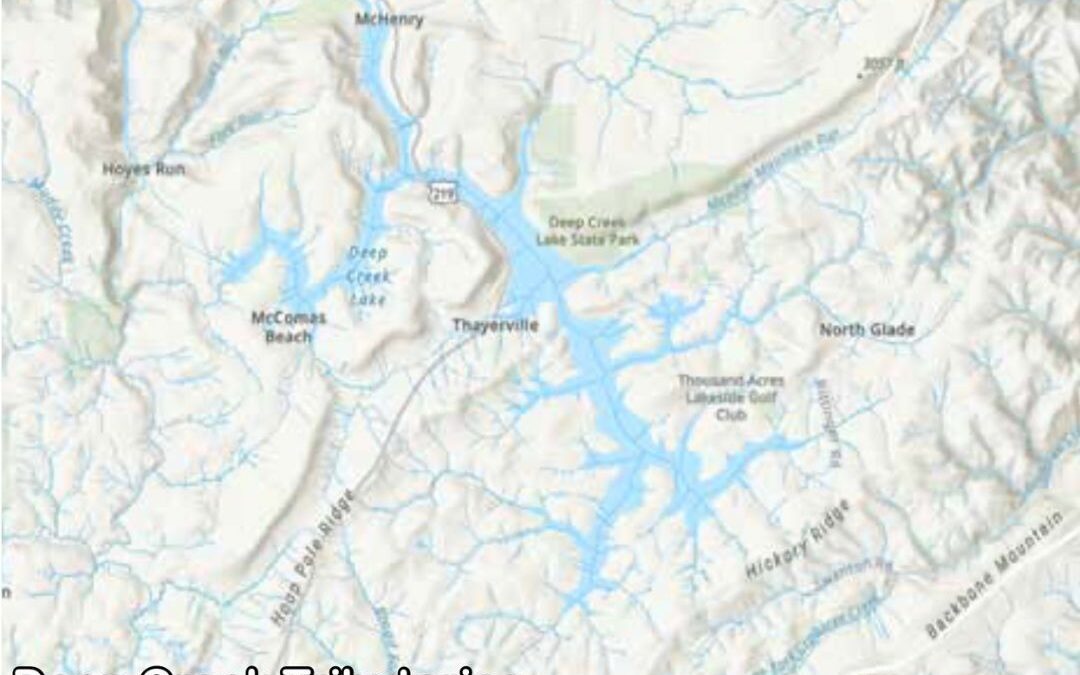
Is there anyone who hasn’t heard of Deep Creek Lake? Even those from other states know of Maryland’s largest man-made lake. Man-made? Yep. There are no natural lakes here in the Free State. In fact, Maryland is the only state without a natural lake. This probably explains why there are no reports of DCL lake monsters like Nessie in Loch Ness, Champ in Lake Champlain, or Ogopogo in Okanagan Lake in British Columbia. Maybe the Chamber of Commerce could do something to correct this oversight. Perhaps a 50-foot waterborne butter-
fly? Dare we mention the ongoing Deep Creek Alligator “joke”?
But being lake-free wasn’t always the case. Once upon a time, there was Buckel’s Bog. It was a 160-acre, shallow glade (a seasonal lake) on the headwaters of the North Branch of the Casselman River. However, this was 12,000 years ago. You probably read about it. It was in all the newspapers at that time. This periglacial bog was discovered through a study of ancient pollen deposits available only because Maryland was not scoured by glaciers during the last Great Ice Age. But, I digress.
DCL is huge by any standards, claiming 3,900 surface acres and 69 miles of shoreline. That expansive shoreline is due to nine major tributaries and numerous smaller ones. Anyway you slice it, that’s a lot of lake-front lawns to mow and probably keeps a lot of lawn maintenance companies and teenagers happy.
DCL’s economic impact is equally super-sized. On an annual basis, there are approximately 1,117,000 visitors bringing in nearly $350 million in total economic impact that supports more than 5,000 jobs. According to the State Department of Assessments and Taxation, there are 948 lakefront dwellings on DCL. With so many benefits, how could it almost not have happened? Seems like such a natural wonder should have been a sure thing. But, don’t forget, DCL is not a “natural” wonder. So, what happened?
In 1910, there was a plan to build three power dams on the Youghiogheny River at Sang Run, Swallow Falls, and Crellin. Notice that Deep Creek was not mentioned. This project was the brainchild of H.P. Tasker, owner of the Youghiogheny Power and Light Company. But, lack of funding blocked the project. In 1914, a second, similar plan also failed to get funding.
In 1921, the Youghiogheny Hydro-Electric Company was given the right to build dams on Deep Creek and the Youghiogheny. They were the third company to be given the rights. So, what happened to those proposed dams?
Somewhere along this time, someone realized that the elevation of Deep Creek in McHenry was 450 feet above the Youghiogheny River. Imagine the potential power created water column standing 450 feet. There was now no need for the Yough dams because this 450-foot water-head, from the present-day DCL dam to the Youghiogheny River electric turbines, would generate all the power needed.
And that, my friends, is how Deep Creek Lake came to be.
But what of its name? Was there a Deep Creek? Yep, and it can still be found on hydrology maps.
The authentic Deep Creek still flows. Its creek bed starts just east of Sand Flat Road, runs east, and soon joins with DCL and then turns north.
The ancient streambed continues northwest, passing under what is now the Route 219 bridge over DCL. From there, it turns southwest, ending at Deep Creek Dam. The original creek bed below the dam eventually joins the Youghiogheny River at a hydroelectric turbine on the shore of the Youghiogheny River. This can be seen in depth charts along with the creek beds for each of another 29 tributaries of DCL.
The current DCL maximum depth is 75 feet. Remember this the next time you decide to canoe or kayak across the lake. Besides, there’s much more to see if you stay close to shore, where you can get out if you need to.
However, is there any evidence that the adjective “deep” was appropriate before the dam was built? Aren’t creeks just smaller rivers? Even the much larger Youghiogheny River has a maximum depth of 58 feet. The Casselman and Savage rivers have a max depth of approximately six feet. Why would we expect Deep Creek to be any different? One possible answer comes from a much earlier, mid-1800s publication.
Ever heard of Meshack Browning? He was one of the early settlers of the Sang Run area.
In his book Forty-four Years of the Life of a Hunter (1859), there is a reference to the depth of Deep Creek. On page 143, he wrote of shooting and wounding a turkey across what he identified specifically as Deep Creek. He lamented that the bird would be lost because it was January, and he did not want to get wet crossing the river. His hunting partner that day was Sam VanSickle, an early settler of the Friendsville area. Browning wrote, “So off we went in the morning, and hunted a long time without success; but by-and-by we heard an old fellow gobbling on the other side of Deep Creek, which had overflowed all the bottoms and glades —from hill to hill being covered with a sheet of water.”
“Well, Sam,” said I, “is not that a pity? We will now lose him, and he will starve to death.” Browning explained VanSickle would not abide such a loss, and so Browning watched as VanSickle undressed before swimming across the creek to retrieve the bird… in January! Brown- ing continued, “He now reappeared, hold- ing the turkey by the neck, and leading him along, telling him at the same time what he might depend on, till he came to the deep channel, when in he plunged again, and swam over to me, holding the turkey with one hand and swimming with the other, through a sheet of water thirty or forty feet wide, and twelve to twenty feet deep.” Would you doubt the word of a hunter and trapper from the late 1850s
… a man who killed bears with only his knife … a man who hunted wolves for their pelts … a man who relied only on hunting to feed his family? You might doubt it, but I don’t.
So, there you have it: Deep Creek Lake almost lost out to proposed Youghiogheny River dams; there really was, and is, a Deep Creek, and a local hunting legend’s own writing proves that Deep Creek was indeed deep. Who knew? Now, you do.
Written by Tony Lolli