
It’s a little-known fact that the Keebler Elves earn pocket money making maple syrup when things are slow at the cracker factory. Why else do you suppose they live in that hollow maple tree? Oh, I know a few of them sneak around after dark, repairing your shoes if you leave them out, but the real money is in maple syrup. And, it’s an all-cash business.
The origin of maple sugaring (making maple syrup from sap) is only hinted at. Long before Europeans arrived in North America, Native Americans were already making maple syrup. Accounts suggest they made bowls by hollowing out pieces of wood to catch the sap that flowed from notches they carved into trees. How they heated the sap enough to make syrup, without burning the wooden bowls, is unknown. Maybe the Keebler Elves should be interrogated.
Vermont takes maple syrup seriously. In 2023, Vermont led U.S. maple syrup production with over 2 million gallons, a title held since the early 20th century.
In 1930, the Vermont State Legislature set standards for commercial syrup production and sale. These were the first such commercial regulations in the US. To be sold at retail, all Vermont syrup must be clear, not hazy. Syrup is then classified into four distinct color classes: Golden, Amber, Dark, and Very Dark. The comparison of the new syrup is gauged against four standard colors in jars.
These days, more modern equipment than wooden bowls is used. Horse-drawn sleds, with a large metal gathering tank, were used from Colonial times. More recently, buckets were carried by hand to collecting bins, through snow, making carriers old before their time.
Beginning in the 1950s, plastic tubing systems were used to connect trees to a central collecting point. Reverse osmosis was also invented. It removes most of the water and shortens the boiling time required. It’s beginning to sound a little too technical, but not if you want to maximize your production.
Maple syrup is measured by hydrometer to ensure that the density, a measure of sugar content, is between 66.9° and 68.9°. This keeps maple syrup shelf-stable and prevents sugar crystallization in the syrup.
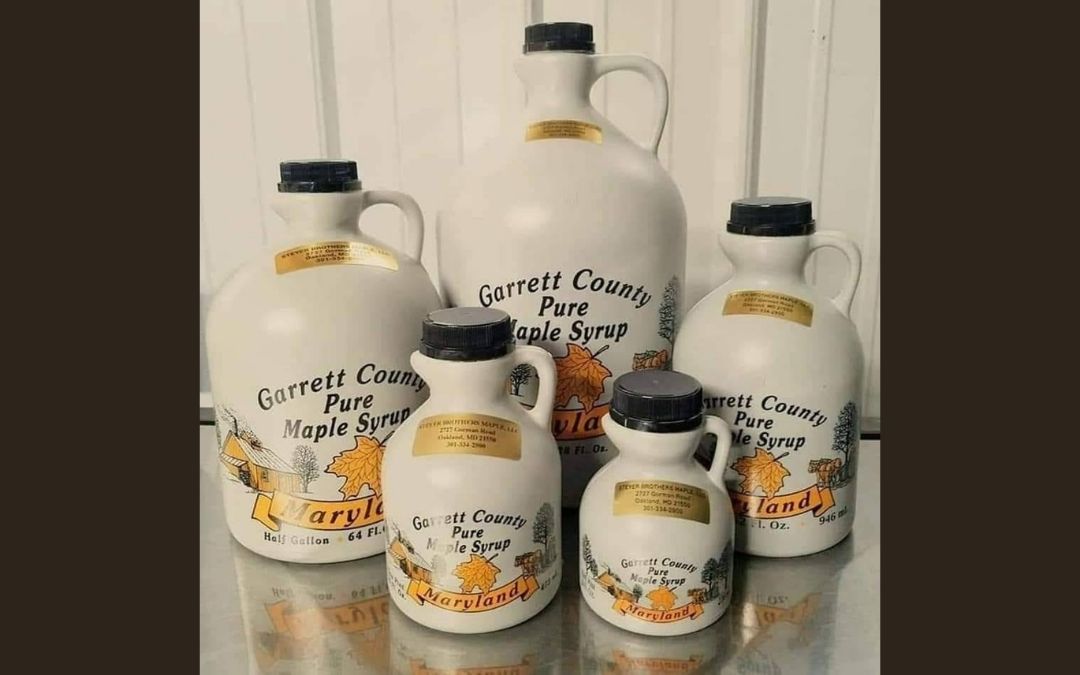
Right here, in Garrett County, we have some big-time maple products operations that have been ongoing for many years. Steyer Brothers Maple has been in business for over 100 years. They’re even on Facebook. But, if you’re technology shy, like me, you can call them at 301-334-2900 and find out which maple products are available at their farm at 2727 Gorman Road in Oakland.
Sleepy Hollow Farm is another local producer of everything maple. Owners Charles and Annetta Enlow’s farming ancestors go back 10 generations, so they know where the best sugarbush is to accommodate the 5,000 taps they use each year. You can call them at 302-746-5234 to find out what maple products are available from their self-serve stand on their front porch at 3345 Friendsville Road in Friendsville.
Suppose you want to try sugaring as a hobbyist? Lots of local folks make extra income by “sugaring”. Advertising is often limited to a sign out by the roadside saying “Maple Syrup Sold Here.”
Having made a few gallons myself, I can tell you it’s not easy money. It’s important to consider all the accoutrements required to go into production.
You’ll need maple trees to provide the sap. An average-sized tree can produce between 5 and 15 gallons of sap per season. You’ll also need a sugarhouse (i.e., a place to hide while you boil 40 gallons of sap to yield each gallon of syrup. If your primary maple trees are red maples, you’ll need 100 gallons of sap to get one gallon of syrup because red maples have a lower percentage of sugar than sugar maples). There’s entertainment value in having all that water vapor billowing out of the sugarhouse cupola. From time to time, a tourist from the Eastern Shore will run up from the road yelling, “Your barn’s on fire! Your barn’s on fire!” It’s always good for a laugh.
Now, how will you get the sap to the sugarhouse, by carrying buckets? Nope. These days, the trees are piped together using plastic tubing. I’m not kidding. The tubing terminates at the sugarhouse, which had better be downhill from the trees. If not, the backflow will cause the trees to swell and explode, spraying sap all over the county and frightening the bears. You can believe me when I say there’s nothing quite as frightening as a sticky, maple-flavored bear. Don’t ask how I know. But, I digress.
You’ll also need lots of wood for fuel. Just because you have maple trees doesn’t mean you have firewood. The irony is that cutting the maple trees for fuel reduces your volume of sap. It’s getting complicated, isn’t it? You sure you want to know more?
Next, you’ll need an arch (fancy talk for a kind of woodstove) and a boiling pan. The boiling pans are not the same as the ones in your kitchen. These look like a 4-by-8-foot mouse maze. It’s designed to evaporate the water as the sap runs from the starting end to the finishing end of the pan. The sap that runs from the trees should not be confused with the sap that runs back and forth feeding the woodstove.
Once the weather warms up so that below-freezing nights alternate with above-freezing days, the sap starts running. As they say, “You have to make hay while the sun shines,” or something like that. The point is that when the sap runs, you make syrup. That’s all you’ll do, day and night, so don’t plan on time to make a beer run to the grocery – you’ll be too busy. You sure you want to get involved with this?
Don’t forget the other necessities, many of which you might already have around the house, if you’re lucky. If not, there’ll be additional startup costs: chain saw ($500); pickup truck ($55,000); fancy cans and jugs to store the syrup for sale ($875); common first aid supplies ($50); uncommon first aid supplies ($150); beer ($200); ambulance and emergency room fees ($23,500).
Written by Tony Lolli